Monday, April 23, 2012

Three days in Paris and 5 hours in Versailles

Last week from Madrid I flew directly to Paris for 3 and a half days. There I hosted an education session for IBM sales folks and met with several IBM customers. I am surprised how well business people speak English in Paris. Not so with taxi drivers :-). One night with my two team mates we went to the traditional French restaurant. Drum roll... and that is where I tasted snails. Turned out to be quite good, especially considering that there was a ton of garlic and spices. I doubt it would taste like much without all this flavoring, but you could say this about almost any food.

The definite highlight of the trip was my visit to Versailles. I had 5 hours to visit the palace on Saturday. What a beautiful place it is!!! One thing I do not understand - why the king's and queen's bedrooms are separate? Did he (or she) snore? :-) Ok, I know kings in France had mistresses, so they needed separate bedrooms. But as much as this palace is beautiful, it does not seem to be designed for living. Entire design is built around showing off the wealth and power, not private quarters where you can relax. There are several floors in the palace - I wonder what else is there - the stuff off the beaten tourist path? Wouldn't it be nice just to wonder around anywhere you wish?

The garden beautifully complements the palace. I only had 1 hour left to walk around, so there is a good reason to come back in the future. I can only imagine how much work is needed to maintain it all in such perfect shape. At the same time, I figure at the $36 entry fee and about 3 million visitors per year (source), they can afford to keep it look pretty :-). The weather forecast the night before predicted sun in the morning and rain starting at 1pm. I had to leave to the airport at 1pm anyway, but was quite surprised when sun disappeared and rain started at 12:50pm. I think French weather folks do much better job than their colleagues in US :-).

I took quite a few photos - click here for the full album. I also have posted photos from my earlier trips to Paris in this album.

Here are just a handful of shots from this trip:


Monday, April 16, 2012

"Origins of Life"

While running for the past couple of weeks, I have listened to "Origins of Life" by Professor Robert M. Hazen, Harvard University lectures. Great course! To spoil it for you - there is no answer to the question. Professor Robert Hazen does not pretend that modern science knows what the true origin(s) of life is (are), but he presents several theories and ongoing research in this area. I must note that Robert Hazen is a great speaker and is very engaging. This is not a "dry scientific" class. This is fun and easy to understand science.

The first lecture gives a quick history of how humans viewed the subject over years and explains theories from ancient Greeks to our days. Some folks thought that life was always "there", others thought it was born when air water and fire came together, etc. There were some experiments with water in sealed containers vs. open containers where water was contaminated and debates over how "life" came into those containers. Professor Hazen gives several examples of debates over years between different scientists and their early crude experiments.

The third lecture discusses the very difficult question - "What is Life?". Can YOU define Life? What is it? How do you know something is "Life" and something is not? It appears there is no agreement in the scientific community on this subject today. There are dozens of definitions, but none that is universally agreed upon. Isn't it amazing that in 2012 there is not clear scientific definition of what the life actually is? Is computer Artificial Intelligence = Life? Is robot alive? Is organic molecule alive? One of the "Life" features is that it is self-replicating. But crystals, fire and other things are self-replicating too. Another characteristic of "Life" is that is responds to external stimulus. But so does water, air and other things. So what is so unique about "Life"? Even until this day there is no clear answer. It seems that so far one of the more popular definitions of life is this: "Any population of entities, which has the properties of multiplication, heredity, and variation.", which means that Life needs to posses the information that passes information from one generation to the next, yet it must display variation - i.e. evolution by natural selection.


One of the lectures covers the topic of "emergence" and "complexity". How do you measure complexity? How do complex forms appear? There is also a very interesting discussion about the Schrödinger's "paradox". Quoting wikipedia: "In a world governed by the second law of thermodynamics, all closed systems are expected to approach a state of maximum disorder. Since life approaches and maintains a highly ordered state - some argue that this seems to violate the aforementioned Second Law implicating a paradox. However, since life is not a closed system, there is no paradox. The increase of order inside an organism is more than paid for by an increase in disorder outside this organism. By this mechanism, the Second Law is obeyed, and life maintains a highly ordered state, which it sustains by causing a net increase in disorder in the Universe."

Indeed - how is it possible that all this "random" set of  atoms and molecules has organized itself into a highly structured and sophisticated assembly of multi-million collections of molecules that we call life? How do those molecules know "what to do"?

One of the lectures in this course talks about the meteorite from Mars - this is infamous Allan Hills meteorite which cause so much controversy when NASA declared that it found life on Mars based on analysis of this meteorite. Here is a wikipedia article on this: http://en.wikipedia.org/wiki/Allan_Hills_84001.
Another lecture talks about several ways one can use to detect life when fossils are not available in the rock. There are methods using carbon weight distribution - comparing the proportion of Carbon 12 to Carbon 13. Organically produced materials tend to have much higher percentage of Carbon 12 compared to non-organic materials. There is great deal of explanation how and why this is done in the lab, the type of equipment used, etc.

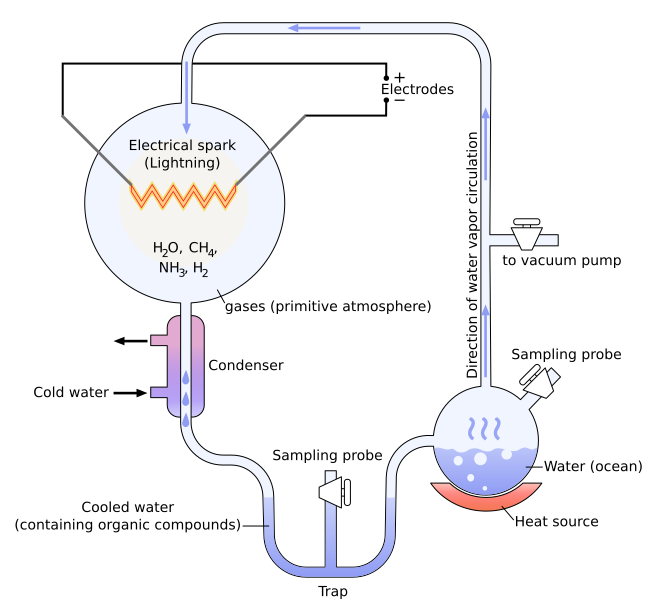
I also loved the lecture that covered the Miller-Urey Experiment in which organic molecules were produced by combining heat, electric sparks and non-organic materials, including water, methane, ammonia, hydrogen. The experiment was done in 1952 and produced over 20 different organic molecules and it is believed that this was a mechanism by which first life building blocks were created 4 billion years ago. Almost 100 years before this experiment, Darwin also suggested similar theory, but he never published his thoughts on the subject - partially being afraid of trouble from "creationists" (and church).

Lets assume we found out how Life came to be. Even bigger question is - where did all the matter come from in a first place? Big bang or not big bang - all this stuff around and inside of us had to show up from "somewhere". I can't accept the answer that it "always existed" nor do I accept theological theories. I am afraid it may take a long time to find this one out...

I just re-read my post above and it feels very dry and boring. Trust me - the lectures are nothing like it. It is so much fun to listen to this course and learn all this stuff. I am not listening to latest episodes of radiolab.org, endurance planet or any other audio, until I finish this :-). And when I do finish, Professor Hazen has another course called "Joy of science". As luck would have it - my library has this course.

I will post updates to this as I continue thru these lectures. For now I am only 1/3rd of the way thru.

Thursday, April 12, 2012

First game of golf

As some of you know, my house is located right next to the golf course. Having lived in it for the past 11 years, I have never played golf. This past weekend kids and I finally did it! It was the first game of golf for my boys and for me! That was a lot of fun. I knew it is not an easy game, and it turned out to be just as hard as I expected. I started counting my strokes on a first holes, but quickly abandoned that idea. It was interesting to watch other golfers play - now I had a different perspective. Amazingly, there are people playing on this golf course starting at 6am in the morning. Next time we play we need to have golf clubs for everyone, not just one set of clubs for the team :-). And we sure will not take a golf car next time - it was fun to drive, but was a drag.


Wednesday, April 4, 2012

Trip to Raleigh, NC

All of last week I have spent in Research Triangle Park in North Carolina at the IBM lab. This was my 10th time to RTP lab. I love RTP - such a great place to live (almost as good as Pittsburgh :-). Back in 2005 I have spent 6 weeks there writing IBM redbook. At that time I took my mountain bike with me and was able to visit many local mt bike trails.

We had a great group of people who came from all over the world  - USA, Germany, Belgium, India, Italy, Egypt. We had a pleasure of working with IBM Distinguished Engineers and architects on the IBM Expert Integrated Systems - to be announced with a big bang on April 11. I wish I could tell you more about this, but I can't :-). This is very very exciting. While in Raleigh, I was recorded on video - here it is:

One of the best moments of last week was a soccer game between all the "visitors" and "hosts" - where we won 9 to 3 :-). To be fair "hosts" gave us their best guy, who used to play soccer semi-professionally. He did not try too hard, or else the score would have been 100:3. Still after 2 hours of this game I had sore muscles for the next 2 days. I guess soccer makes you use different groups of muscles and in a different way (anaerobic) and my triathlon training made me survive the game well, but did not help with the next two days - I had to use my hands to lift feet in and out of the car :-)).

One thing I did not like was that the Fairfield hotel gym did not have bike trainers, so I went entire week with no bike mileage. Only running in the neighborhood and swimming at the local YMCA (25 min drive). Next time I stay somewhere for a week or more I will call hotel in advance to check if their gym has bikes or not.

Sunday, March 25, 2012

Backyard zip line project

WARNING !!! Zip lines could be very dangerous. Once you install your zip line, please test it with weights to make sure cable is secured and the speed of descent using your pulley is safe. DO NOT put your child on zip line before you test it. WARNING !!! 

FOR SALE - this entire zip line assembly is now for sale. Please contact me if you are interested to purchase all of the items seen on this page for $200 (shipping extra). This includes - turnbuckle, mounting hardware, cable, pulley, handlebar, connectors. (kids are extra :-).This is a pretty good deal as I have paid close to $350 for all this and had to make numerous trips to different shops to pull it together.

Today we had completed a fun project with my kids - installed a zip line in our backyard. We usually setup a very small 30 feet zip line once a year and use rope for that, but rope is very stretchy and does not work well for zip lines. This time we decided to do it “right”. We went to Lowes and picked up 145 feet of the heaviest metal cable they carry along with two pulleys and fastening hardware for the cable. My backyard has about 6 degree slope and we installed zip line parallel to the ground. Both ends of the cable we connected to the pine trees on the left and right sides of my yard. we have put wooden blocks between the cable and the tree so that cable does not damage the tree bark. I used router tool to make grooves in those wooden blocks so cable will be held in one place. The blocks were nailed to the tree trunk.

We tried using one pulley at first and that was not working well. Instead we cut two strong metal stripes and connected two pulleys together.
The hardest part was tightening the cable. I really wish we had a tool for that. Instead we used a metal bar as a lever to pull the cable. Total length of the zip line is about 135 feet (~41 meters), so the cable is pretty heavy and still has a bit of sag. However this sag is not too bad since it helps to control the speed when kids slide down the line. Just about 8 feet away from the end of the line we have put a stopper on the cable so that the rider does not crash full speed into the tree. This stopper is just a simple metal clamp on the cable – the same kind we used to fasten the cable to the trunk of the tree. Instead of using handlebars we decided to just use the rope with several loops for hands and feet – depending on the size of the rider he could use loops at different height and just “stand” with his feet in the loop, instead of just hanging on with his hands only. This really helps since at the end of the zip line the pulley hits the stopper on the cable and the rider swings forward somewhat violently and can be thrown off the line if not holding on the rope well enough.


This was a pretty easy project to do, only took about 2 hours and now my boys (and neighbors’ kids) are having a blast.

May 2012 update:
After kids having been using zip line for some time, the rollers completely worn out to the core. These rollers were Lowes $4 a piece (I have two of them coupled) and I need to replace with new ones (which wont last for more than another couple of months), or better yet get a quality rollers really designed for this kind of stuff.

The cable  also has stretched quite a bit and I have inserted a turnbuckle (18" for $30) to tighten the cable when I need it. They sell it at one local company called Pennsylvania Sling Company. These guys have an amazing assortment of cables, turnbuckles of any size and all kids of other cool stuff made of metal - all with very reasonable prices. I wish I knew about them before I went shopping for zip line supplies to Lowes. Comparing Lowes and this "Sling" store for zip line stuff is like comparing Seven Elleven (being Lowes) and Wal Mart.

Major problem was with the proper tightening of the steel cable. Here is how I accomplished it (you need at least 2 people to do it):

June 2012 update: 
After my kids have used this setup for a couple of months, the $5 pulley that I have purchased at Home Depot is now completely wasted. In fact, it got wasted looong time ago. The problem is that wheels on that pulley are copper and when you use it on steel cable those wheels get worn out extremely quickly. It really only took a couple of weeks for that pulley to become defunct and zip line was sitting not being used. So I bit the bullet (price-wise) and went on to buy a nice PETZL steel pulley on Amazon for about $79 (ouch!) plus steel handle, etc. all in all for $120. Here is a photo of the pulley (it is tiny!) and steel handlebar:
Once I have put the pulley on the line, I had no idea how fast would it go and expected it to be no faster than the first pulley I bought at Home Depot. What a mistake it was... I should have tested it before I asked my son to ride it. He went down zip line extremely fast - probably twice as fast as with the original pulley (or so it seemed to me). At the end I do not have a soft stop with wood block and rubber, etc. I just have a clamp on the cable. When he came down that part - pulley hit the clamp and I was standing ready - just in case. However I did not even have time to react... My son flew off that thing and hit the ground hard. Lucky him (and me...) - he did not even have a bruise as he got up instantly and just said he wont ride it again until I do something to lower the speed. Hell, yes. I took of the pulley right away and now need to find the time to lower the overall angle of the zip line to reduce the speed. Boy, this was scary experience and I should have known better.

Again - TEST zip line with something other than your kids (or at least do it yourself) before letting children ride it. At least this is what I would do next time.

UPDATE - August 2013. I decided to dismantle this zip line for safety reasons. There are too many risks of different kind involved here and I want my and neighbor's kids to be safe above having fun.

Monday, March 19, 2012

4 days long spring in Pittsburgh

In my house the winter starts when I change tires from summer to winter tires. The spring starts when I change back to summer tires. As of last night - the spring is officially here (as are my summer tires).

Winter 2011-2012 in Pittsburgh was warm and I only got to ski twice - once on my cross country skis on the golf course that is next to my backyard and once with kids in Nemacolin resort on downhill skis. Having such unusually warm winter with so little snow, it was even stranger to go from that winter to summer in 4 days. We had frost and 30F cold in early March, and then 4 days later it was sunny with 65F and stays this way for over a week now. How about a 4 day spring? (I hope I don't make some folks in Seattle jealous of this :-).


Yesterday it was 72F and I went for a 9.2 miles run in North Park - almost none of the trees have leaves yet, but you can smell and feel the spring. I took some pictures with the iPhone while running:


Friday, March 9, 2012

The best kept secret in Pittsburgh

Just a couple of months ago I was lucky to be invited to an event hosted by IBM in one of the lesser known places in Pittsburgh. I have never heard of that place before and most people I asked did not know anything about it either. The event happened to be hosted in the Roberto Clemente Museum (http://www.clementemuseum.com) located only 10 min from Pittsburgh downtown. The museum is privately owned by a well known Pittsburgh photographer - Duane Rieder (http://riederphotography.com). Duane bought the old firehouse about 15 years ago and mostly with his hands restored it to a pristine shape, built a museum on the main floor, photo studio and part of the museum on the second floor and a wine cellar in the basement. He processes about 30 tons of grapes and makes and stores his wine in that basement. He sells a lot of that wine to Pittsburgh Pirates, Steelers and Pinguins. The most amazing part of this whole thing is that Duane seems to do most of this stuff himself - with few helpers. I am not a baseball fan, but I was totally impressed with the museum - there is Clemente's silver bat, one of his golden gloves, championship rings and tons of other memorable things, not to mention photos, documents, etc. VERY very impressive. If you love baseball - this is like a central baseball church on earth :-).

I had my iPhone with me, so I took some pictures (more photos here).


Monday, March 5, 2012

Pittsburgh Phipps Conservatory

One of my favorite places in Pittsburgh is our Phipps Conservatory. If you ever visit Pittsburgh - this is a must see location.We go there with the whole family several times a year and the best part is that Phipps changes exhibit to match the season. This is truly a paradise for photographers - all year long. I have posted Picasa Album with some of the photos I took there: https://picasaweb.google.com/115098171996656963581/PittsburghPhippsConservatory#slideshow (46 photos). Here are some of those pictures (taken with different cameras over years):


Saturday, March 3, 2012

Corn maze navigation

I love mazes and have always wanted to navigate large maze. here in Pennsylvania there are beautiful mazes made each year on corn fields. Just imagine a full size large corn field and a maze cut in it. From what I understand, they do not really cut it, they just plant corn in a pattern, so it grows as a maze from the get go. Seems like it take a lot less work to do it that way, instead of cutting after corn grows to be twice as tall as human. This past fall my family and our friends went to one such maze. It was a blast! To make it easier they gave us a map. On the map they have set "treasure points" so you have to find all of them. It took us over an hour to navigate all the points. It was a great day and next time we go, I think we will try to do it without the map. We will be sure to take our flashlights in case we get stuck. Here is their site: http://www.coolspringmaze.com.

Here are few pictures, but you can see more in the Corn Maze slideshow: https://picasaweb.google.com/115098171996656963581/CornMaze2011#slideshow.
 This is a real picture from the airplane - amazing, hah?


Saturday, February 25, 2012

"Psychology of Human Behavior"

Recently I borrowed the lectures "Psychology of Human Behavior" by Professor David W. Martin from my local library and while I run listen to these. Fascinating stuff. Learned a ton of new things about human psychology, human nervous system, Freud and his psychoanalytic theory, mental illnesses, depressions, and bunch of other cool stuff. Total of 18 hours of lectures. For example, yesterday while I was running on the trail in the woods the lecture #13 was about psycho-surgeries, lobotomy, electric convulsive shock therapy, future gene therapy and things like that.

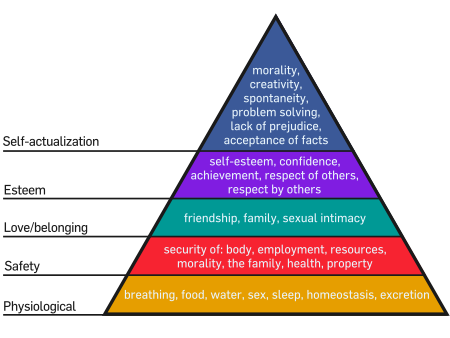
The further along I get in this course - the more interesting it gets. The lecture18 on human motivation talked about the Maslow pyramid of human needs as well as other theories of human motivation.

Lectures 19 and 20 are on human emotions and how to measure those as well as different theories that explain emotions and their "mechanics". It was quite interesting to learn about the experiment by Edward Diener who conducted an experiment on 1.1M people worldwide and found that on average people are rating themselves happy at about 6.5 on 0 to 10 scale - regardless of their income, health, geographic location, etc. Quoting wikipedia: In 2002, Diener conducted a study at the University of Illinois with Martin Seligman, finding that "the most salient characteristics shared by the 10% of students with the highest levels of happiness and the fewest signs of depression were their strong ties to friends and family and commitment to spending time with them... It is important to work on social skills, close interpersonal ties and social support in order to be happy." Diener's research showed that once a person's "basic needs are met, additional income does little to raise your sense of satisfaction with life." 


Lectures 21 and 22 discuss different drugs (marihuana, alcohol, opium, crack, cocaine, LSD, depressants, etc.) and how these drugs work at the neuron level, withdrawal symptoms, and other effects of drugs on humans. I must admit to have learned quite a few interesting things about drugs, for example the fact that the TI (therapeutic index) of alcohol is about 5, while TI of marihuana is about 35,000. What is TI? In simple terms it is the ratio of lethal doze to the therapeutic doze. In other words if you drink 5x the amount of alcohol compared to the amount to get you "well drunk" there is about 50% chance you may die (i.e. 6-10 glasses of vodka can kill you depending on your tolerance level).

Take a set of CDs from your library and that should give you plenty of time to listen. Here is a description of the course: http://www.thegreatcourses.com/tgc/courses/course_detail.aspx?cid=1620. If your library does not have this, you can get these lectures from Amazon.

The Teaching Company (they are now called The Great Courses) has lots of other great lectures and your library probably has some good ones.

North Park photowalk

Few weeks ago I took my younger son to North Park and we did "photo walk" with him. It was so much fun - we both enjoyed it tremendously. It was dusk time and the lighting was perfect. We also took some pictures well after sunset in the darkness. Good thing I had tripod and could use high ISO. Can't wait to do it again with him.

Here is the full slideshow of all of 36 photos.

Here are just some of those pics: