Showing posts with label Stuff to read. Show all posts

Tuesday, December 24, 2013

Lost in Mongolia (documentary book and movie)

Last year I've read the book “Beyond the Horizon” by Colin Angus, the Canadian adventurer who completed the journey around Earth in less than two years using his muscle power alone. No motors, no sails – only the power of his arms and legs. He traveled total distance of 43,000 km from Vancouver by bike to Alaska, rowed thru the Bering Sea, biked and trekked all across Siberia via Moscow to Portugal, rowed across Atlantic to Costa Rica and biked back to Vancouver.

Colin has made a handful of other epic trips and written books about those. The one I just finished is called "Lost in Mongolia". Colin and his crew were the first in the history of mankind to navigate all 5,500 km of Yenisey river from its start in mountains of Mongolia, thru Russian Siberia to Arctic Ocean. They also filmed a movie of their adventures (I bought a DVD and watched it with kids this past weekend).

I like Colin's writing style, not to mention how much I love his adventures. Very powerful stuff and not only because of adventures, but also because of the cultural experiences as this human interaction is one of the biggest aspects of the trip for Colin and his crew. Since I am originally from Russia, it was particularly interesting to read about his experience in Siberia and the kind of people and support he had while being in this tough land. Fortunately and unfortunately his experience does sound very much like real Russia these days.

Colin's team has spent over 5 months on the river and had a whole lot of fun. This makes me want to take a rafting or kayaking trip in the summer of 2014. Perhaps for 5 days? No, not on Yenisey river :-), perhaps Boundary Waters?

Saturday, July 21, 2012

The Perfect Mile

The Perfect Mile: Three Athletes, One Goal, and Less Than Four Minutes to Achieve It
Just finished the audio version of this book. Absolutely one of the best sports books I have enjoyed so far. This book is beautifully written and you can't put down once you start it! The plot is real and fascinating! The story tells how three runners in 1950s attempted to break the 4 minute mile barrier, which was once considered to be impossible. Those runners were Roger Banister of UK, John Landy of Australia, and Wes Santee of US.

I do not want to spoil the book for you and tell who was the first runner to accomplish this goal, but I bet even non-runners would love this book. You just can't find too many stories like that, with so much drama, action and amazing examples of the best that humans have.

Wikipedia has a great article documenting the history of the one mile records. SPOLIER ALERT: Do not look at it before you read the book! Here is the article.The current mile record was set in 1999 and is 3:43.13. Amazing.

All this one mile stuff makes me want to try how fast can I run one mile. I will try some time later this year and will post my result. For now I am curios - can I run at least 5 min mile? This year my best pace per mile was 6m 27sec during the 3 miles run at the sprint triathlon (for those of you unaware this run is after 500 yards swim and 14.5 miles bike). My average pace at the marathon last year over 26.2 miles was 7min 43sec per mile. Compare that to the world record marathon pace of 4min 43 sec per mile! Isn't it crazy?

Saturday, May 26, 2012

The first human-powered circumnavigation of the Earth


This post is going to be very emotional.  I am completely blown away and struck in awe. No, I did not complete the journey around the earth myself (although I am typing it as I am sitting on the plane from Delhi to Frankfurt and total distance I traveled over the past seven days by plane is enough to circle the Earth as I have taken total of 9 flights and spent about 38 hours in air plus about 15 hours in airports waiting for connections). Being on the modern airplane in a comfort of a seat, eating warm food, relaxed, answering emails on a laptop and dozing off when desired is easy. The reason I am blown away is the “Beyond the Horizon” book I just finished reading few minutes ago. The book is written by Colin Angus (http://www.angusadventures.com) – the Canadian adventurer who completed the journey around Earth in less than two years using his muscle power alone. No motors, no sails – only the power of his arms and legs. He traveled total distance of 43,000 km from Vancouver by bike to Alaska, rowed thru the Bering Sea, biked and trekked all across Siberia via Moscow to Portugal, rowed across Atlantic to Costa Rica and biked back to Vancouver. This was done on a tiny budget with very little sponsorship and support from outside. The book is an amazing documentary of his travel and is utterly captivating. I could not put it down until I finished it (this redeye flight from Delhi to Frankfurt is 10 hours). He also has produced a documentary movie (can’t wait to watch it when I get home!) The experiences in the book are hard to believe – but even if only tenth of it is true, it is still amazing (although I do not doubt any of his writing – it is just hard to imagine these things are even possible). 
 The book is very well written and is a truly one of the best documentaries I have ever read. It reads like a thriller J. For those of you who know me, in the past 10 years or so I almost stopped reading fiction writings. I feel like wasting my time reading fiction (with few exceptions). Fiction can be entertaining, but it is still a fiction. On the other hand scientific books or documentaries fascinate me. They are “real”. Documentaries are especially special as they show what humans are capable of doing when focused and persistent. This book is very inspirational. Here is a short video from this trip around the world - a snippet form the full documentary film.

Next time I am doing something hard, I will remember the struggles Colin had. It has been my dream for the past few years to go on bike from Pittsburgh to Washington DC. Now I am certain that I will do it (hopefully with my kids).  I think it is only about 300 miles, so should take less than a week to complete.
I am typing the end of this post now sitting in Frankfurt airport and looking at the new Airbus A380 – the Dreamliner. Too bad it is not what I will fly back to US. But Boeing 747 is not too bad. Better than rowing across the ocean for 5 months… or not?

Monday, April 16, 2012

"Origins of Life"

While running for the past couple of weeks, I have listened to "Origins of Life" by Professor Robert M. Hazen, Harvard University lectures. Great course! To spoil it for you - there is no answer to the question. Professor Robert Hazen does not pretend that modern science knows what the true origin(s) of life is (are), but he presents several theories and ongoing research in this area. I must note that Robert Hazen is a great speaker and is very engaging. This is not a "dry scientific" class. This is fun and easy to understand science.

The first lecture gives a quick history of how humans viewed the subject over years and explains theories from ancient Greeks to our days. Some folks thought that life was always "there", others thought it was born when air water and fire came together, etc. There were some experiments with water in sealed containers vs. open containers where water was contaminated and debates over how "life" came into those containers. Professor Hazen gives several examples of debates over years between different scientists and their early crude experiments.

The third lecture discusses the very difficult question - "What is Life?". Can YOU define Life? What is it? How do you know something is "Life" and something is not? It appears there is no agreement in the scientific community on this subject today. There are dozens of definitions, but none that is universally agreed upon. Isn't it amazing that in 2012 there is not clear scientific definition of what the life actually is? Is computer Artificial Intelligence = Life? Is robot alive? Is organic molecule alive? One of the "Life" features is that it is self-replicating. But crystals, fire and other things are self-replicating too. Another characteristic of "Life" is that is responds to external stimulus. But so does water, air and other things. So what is so unique about "Life"? Even until this day there is no clear answer. It seems that so far one of the more popular definitions of life is this: "Any population of entities, which has the properties of multiplication, heredity, and variation.", which means that Life needs to posses the information that passes information from one generation to the next, yet it must display variation - i.e. evolution by natural selection.


One of the lectures covers the topic of "emergence" and "complexity". How do you measure complexity? How do complex forms appear? There is also a very interesting discussion about the Schrödinger's "paradox". Quoting wikipedia: "In a world governed by the second law of thermodynamics, all closed systems are expected to approach a state of maximum disorder. Since life approaches and maintains a highly ordered state - some argue that this seems to violate the aforementioned Second Law implicating a paradox. However, since life is not a closed system, there is no paradox. The increase of order inside an organism is more than paid for by an increase in disorder outside this organism. By this mechanism, the Second Law is obeyed, and life maintains a highly ordered state, which it sustains by causing a net increase in disorder in the Universe."

Indeed - how is it possible that all this "random" set of  atoms and molecules has organized itself into a highly structured and sophisticated assembly of multi-million collections of molecules that we call life? How do those molecules know "what to do"?

One of the lectures in this course talks about the meteorite from Mars - this is infamous Allan Hills meteorite which cause so much controversy when NASA declared that it found life on Mars based on analysis of this meteorite. Here is a wikipedia article on this: http://en.wikipedia.org/wiki/Allan_Hills_84001.
Another lecture talks about several ways one can use to detect life when fossils are not available in the rock. There are methods using carbon weight distribution - comparing the proportion of Carbon 12 to Carbon 13. Organically produced materials tend to have much higher percentage of Carbon 12 compared to non-organic materials. There is great deal of explanation how and why this is done in the lab, the type of equipment used, etc.

I also loved the lecture that covered the Miller-Urey Experiment in which organic molecules were produced by combining heat, electric sparks and non-organic materials, including water, methane, ammonia, hydrogen. The experiment was done in 1952 and produced over 20 different organic molecules and it is believed that this was a mechanism by which first life building blocks were created 4 billion years ago. Almost 100 years before this experiment, Darwin also suggested similar theory, but he never published his thoughts on the subject - partially being afraid of trouble from "creationists" (and church).

Lets assume we found out how Life came to be. Even bigger question is - where did all the matter come from in a first place? Big bang or not big bang - all this stuff around and inside of us had to show up from "somewhere". I can't accept the answer that it "always existed" nor do I accept theological theories. I am afraid it may take a long time to find this one out...

I just re-read my post above and it feels very dry and boring. Trust me - the lectures are nothing like it. It is so much fun to listen to this course and learn all this stuff. I am not listening to latest episodes of radiolab.org, endurance planet or any other audio, until I finish this :-). And when I do finish, Professor Hazen has another course called "Joy of science". As luck would have it - my library has this course.

I will post updates to this as I continue thru these lectures. For now I am only 1/3rd of the way thru.

Saturday, February 25, 2012

"Psychology of Human Behavior"

Recently I borrowed the lectures "Psychology of Human Behavior" by Professor David W. Martin from my local library and while I run listen to these. Fascinating stuff. Learned a ton of new things about human psychology, human nervous system, Freud and his psychoanalytic theory, mental illnesses, depressions, and bunch of other cool stuff. Total of 18 hours of lectures. For example, yesterday while I was running on the trail in the woods the lecture #13 was about psycho-surgeries, lobotomy, electric convulsive shock therapy, future gene therapy and things like that.

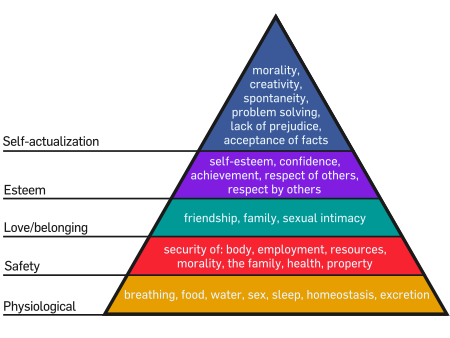
The further along I get in this course - the more interesting it gets. The lecture18 on human motivation talked about the Maslow pyramid of human needs as well as other theories of human motivation.

Lectures 19 and 20 are on human emotions and how to measure those as well as different theories that explain emotions and their "mechanics". It was quite interesting to learn about the experiment by Edward Diener who conducted an experiment on 1.1M people worldwide and found that on average people are rating themselves happy at about 6.5 on 0 to 10 scale - regardless of their income, health, geographic location, etc. Quoting wikipedia: In 2002, Diener conducted a study at the University of Illinois with Martin Seligman, finding that "the most salient characteristics shared by the 10% of students with the highest levels of happiness and the fewest signs of depression were their strong ties to friends and family and commitment to spending time with them... It is important to work on social skills, close interpersonal ties and social support in order to be happy." Diener's research showed that once a person's "basic needs are met, additional income does little to raise your sense of satisfaction with life." 


Lectures 21 and 22 discuss different drugs (marihuana, alcohol, opium, crack, cocaine, LSD, depressants, etc.) and how these drugs work at the neuron level, withdrawal symptoms, and other effects of drugs on humans. I must admit to have learned quite a few interesting things about drugs, for example the fact that the TI (therapeutic index) of alcohol is about 5, while TI of marihuana is about 35,000. What is TI? In simple terms it is the ratio of lethal doze to the therapeutic doze. In other words if you drink 5x the amount of alcohol compared to the amount to get you "well drunk" there is about 50% chance you may die (i.e. 6-10 glasses of vodka can kill you depending on your tolerance level).

Take a set of CDs from your library and that should give you plenty of time to listen. Here is a description of the course: http://www.thegreatcourses.com/tgc/courses/course_detail.aspx?cid=1620. If your library does not have this, you can get these lectures from Amazon.

The Teaching Company (they are now called The Great Courses) has lots of other great lectures and your library probably has some good ones.